Smoothed Differentiation
Experimental
Smoothed differentiation is experimental and currently supports problems with zero, nonnegative, and second-order cones (LPs, QPs, and SOCPs). Support for exponential and power cones is planned.
When differentiating through a conic solver, the gradients can be discontinuous at points where the active set changes (e.g., a constraint switches between active and inactive). Smoothed differentiation addresses this by computing gradients from a nearby point on the central path rather than the exact solution, producing smooth gradient curves that are better behaved for gradient-based optimization.
Usage
Enable smoothed differentiation via IPMSettings:
import moreau

settings = moreau.Settings(
    enable_grad=True,
    ipm_settings=moreau.IPMSettings(
        diff_method='smoothed',
        diff_smoothing_mu=1e-4,   # smoothing level (default)
    ),
)
The diff_smoothing_mu parameter controls the amount of smoothing. Larger values produce smoother gradients at the cost of accuracy relative to the exact solution; smaller values are closer to the exact (possibly discontinuous) gradients.
This works with all Moreau APIs: NumPy backward(), PyTorch autograd, and JAX grad.
Active-Set Solver
The active-set solver (solver='active_set') also supports smoothed differentiation
with the same central-path approach, configured via ActiveSetSettings:
settings = moreau.Settings(
    solver='active_set',
    enable_grad=True,
    active_set_settings=moreau.ActiveSetSettings(
        diff_method='smoothed',
        diff_smoothing_mu=1e-4,
    ),
)
The active-set solver’s smoothed mode uses the same S/Z regularization as the IPM,
producing equivalent C^∞ gradients through constraint transitions. The default
diff_method='exact' is faster but discontinuous at active-set changes.
PyTorch
from moreau.torch import Solver

solver = Solver(
    n=n, m=m,
    P_row_offsets=P_ro, P_col_indices=P_ci,
    A_row_offsets=A_ro, A_col_indices=A_ci,
    cones=cones,
    settings=moreau.Settings(
        ipm_settings=moreau.IPMSettings(
            diff_method='smoothed',
            diff_smoothing_mu=1e-3,
        ),
    ),
)

solution = solver.solve(P_values, A_values, q, b)
solution.x.sum().backward()  # smooth gradients
JAX
import jax
from moreau.jax import Solver

solver = Solver(
    n=n, m=m,
    P_row_offsets=P_ro, P_col_indices=P_ci,
    A_row_offsets=A_ro, A_col_indices=A_ci,
    cones=cones,
    settings=moreau.Settings(
        ipm_settings=moreau.IPMSettings(
            diff_method='smoothed',
            diff_smoothing_mu=1e-3,
        ),
    ),
)

grad_fn = jax.grad(lambda q: solver.solve(P_data, A_data, q, b).x.sum())
dq = grad_fn(q)  # smooth gradients
Effect of Smoothing
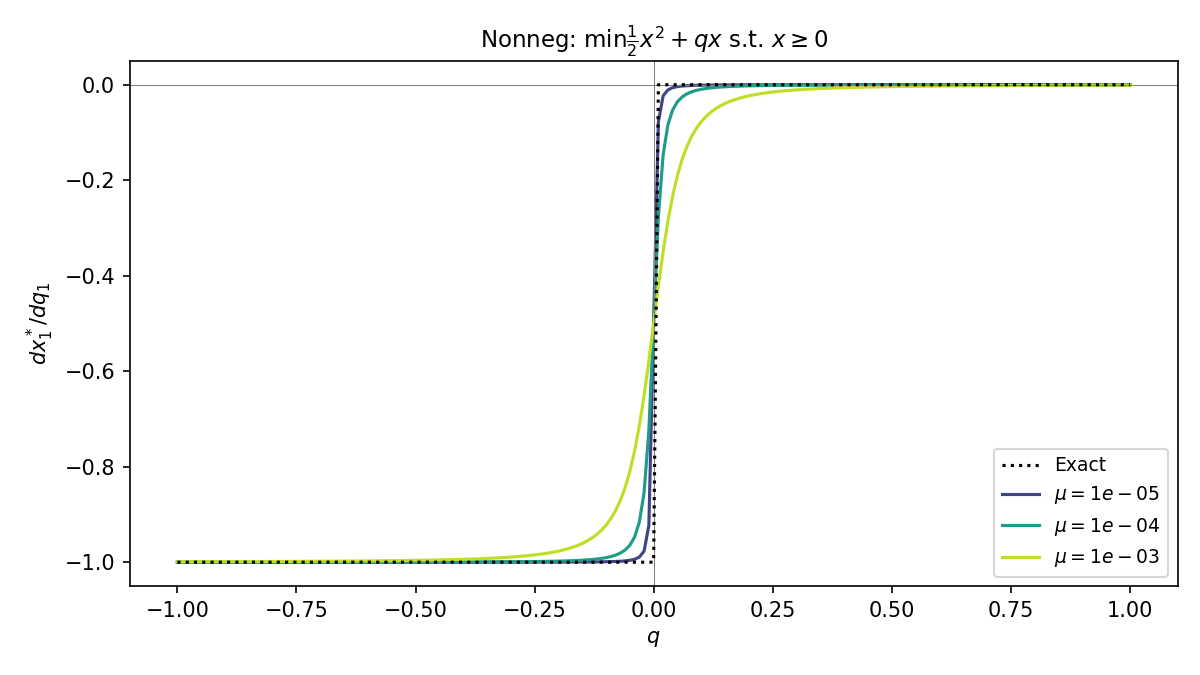
The plot below shows how smoothed differentiation affects the gradient \(\partial x^* / \partial q\) for a simple nonnegative-cone problem. The problem is parameterized by a scalar \(q\) that sweeps through a non-differentiable point (where the active set changes). The exact gradient (dashed black) has a sharp discontinuity; the smoothed gradients (colored curves) replace this with a smooth transition. Larger \(\mu\) produces more smoothing.
Nonnegative Cone
How It Works
The standard (exact) backward pass differentiates the KKT conditions and uses the Jacobian \(H = D\Pi_{\mathcal{K}^*}(u)\) of the dual cone projection. This Jacobian is discontinuous at cone boundaries.
Smoothed differentiation replaces \(H\) with
where \(\varphi^*\) is the dual barrier function and \(z_\mu\) is a point on the central path with average complementarity \(\mu\). This operator is \(C^\infty\) in both \(\mu\) and the problem data.
Obtaining the smoothing iterate
After the IPM converges to a high-accuracy solution, Moreau performs post-convergence refinement: it walks the complementarity \(\mu\) back up from \(\approx 0\) to \(\mu_\text{target}\) using pure centering steps. This produces an iterate that is approximately on the central path (near-feasible with the desired complementarity level) without affecting the forward solution quality.
The refinement typically takes 2–3 additional KKT factorizations, adding 30–50% overhead relative to the base solve. This cost is modest relative to the backward pass itself, which also requires a KKT factorization.
Settings Reference
Parameter |
Default |
Description |
|---|---|---|
|
|
|
|
|
Target smoothing level. Larger = smoother. |
|
|
Controls how aggressively each refinement step increases \(\mu\). |
These are set on IPMSettings and passed to Settings:
settings = moreau.Settings(
    enable_grad=True,
    ipm_settings=moreau.IPMSettings(
        diff_method='smoothed',
        diff_smoothing_mu=1e-3,
    ),
)
When to Use Smoothed Differentiation
Use smoothed when:
Training with gradient descent and the loss landscape has kinks from active-set changes
Gradients are noisy or jumpy and you want a stabilizing effect
You need gradients that vary continuously with problem parameters
Use exact (default) when:
You need the most accurate gradients possible
Your problem parameters don’t cross active-set boundaries during optimization
You’re computing sensitivities rather than training
Limitations
Currently supports zero, nonnegative, and second-order cones (LPs, QPs, and SOCPs). Using
diff_method='smoothed'with exponential or power cones will raise an error. If you need smoothed differentiation for other cone types, please open an issue.Adds overhead from post-convergence refinement iterations (typically 30–50%).